Research
VRX-0075: The Quintuple Agonist That Outperformed Retatrutide in Obese Rats
A preclinical five-receptor agonist nicknamed 'GLP-5' produced greater weight loss than retatrutide in a diet-induced obese rat model presented at ADA 2026. BioMaxFit examines what the animal data actually show, why the amylin axis is the new frontier, and why a rat readout is directionally interesting — not decisive.
Educational & research use only. Not medical advice — we do not sell or promote any compounds. Read the full disclaimer.
A Five-Receptor Molecule Built on a Retatrutide Backbone
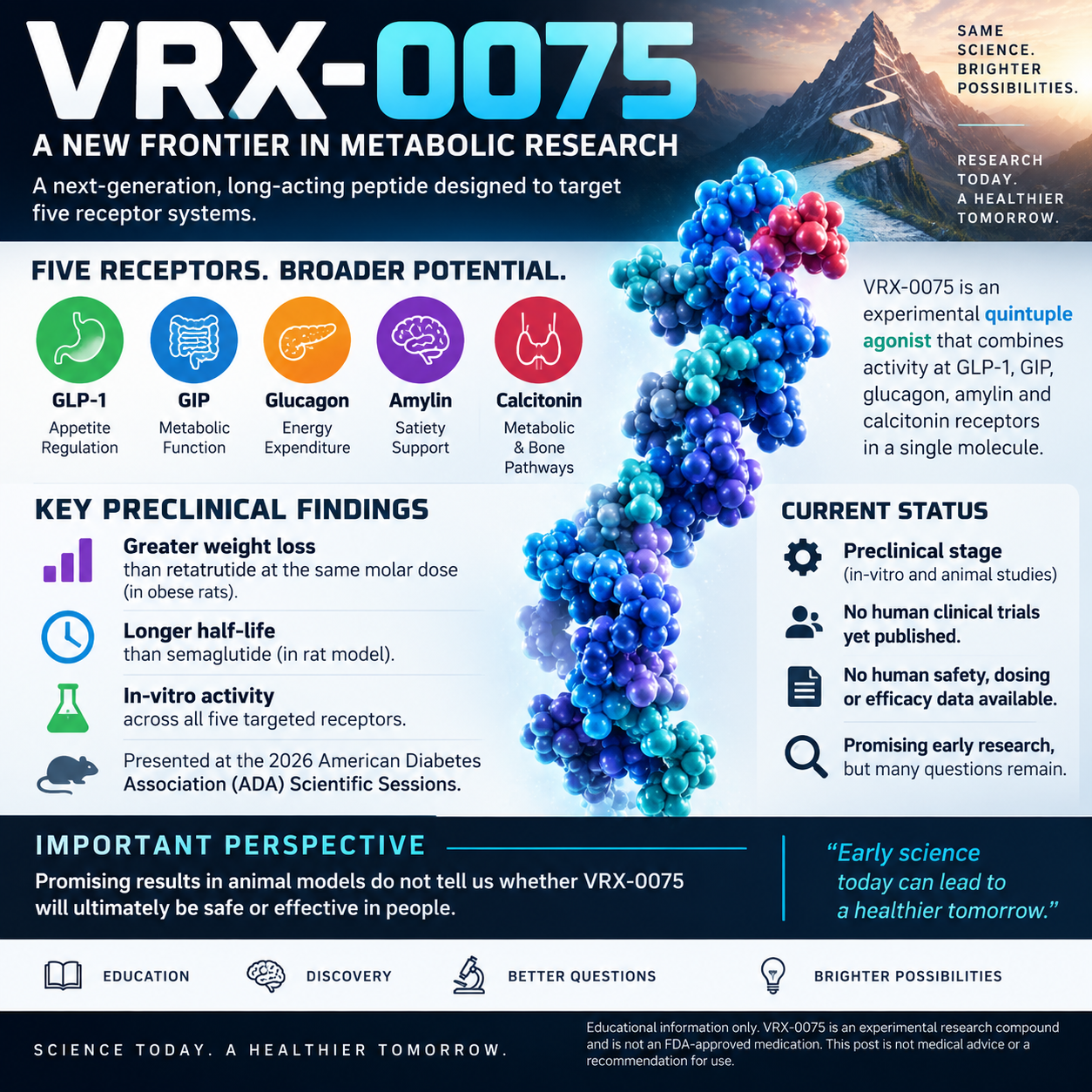
At the American Diabetes Association's 2026 Scientific Sessions, a preclinical compound designated VRX-0075 quietly achieved something the leading late-stage obesity peptide has not: it outperformed retatrutide in a head-to-head animal model. Presented as late-breaking poster 2839-LB, VRX-0075 is described as a long-acting quintuple agonist engineered to activate five receptor pathways within a single molecule — GLP-1, GIP, glucagon, amylin, and calcitonin.
In research-community circles the compound has been informally nicknamed "GLP-5" for its five-receptor design. That label is colloquial shorthand rather than an official drug class; no receptor named GLP-5 exists. The significance of the molecule lies not in the nickname but in the architecture: it fuses the incretin and glucagon axis that retatrutide pioneered with the satiety and gastric-emptying axis that cagrilintide and eloralintide represent.
BioMaxFit is a research and development educational platform. The following analysis is provided strictly for educational and informational purposes. BioMaxFit does not sell, promote, or represent any compound, and nothing here constitutes medical advice or a recommendation to acquire, use, or self-administer any substance.
What the ADA 2026 Data Showed
The poster describes VRX-0075 as a long-acting agonist built to engage five receptor pathways simultaneously. The headline finding: in a diet-induced obese rat model, VRX-0075 induced greater weight loss than retatrutide at a matched molar dose.
The receptor design is central to the result. Reported in-vitro potency is comparable to retatrutide at the three incretin-axis receptors — GLP-1, GIP, and glucagon — while matching cagrilintide's potency at the amylin and calcitonin receptors. In effect, the molecule bolts the amylin and calcitonin satiety mechanism onto a retatrutide-style triple-agonist backbone.
The abstract also reported a half-life approximately 50% longer than semaglutide, which the authors framed as supporting once-weekly dosing should the molecule advance into human trials. No human dosing, safety, tolerability, or efficacy data were presented. This is a preclinical readout only.
Why the Amylin Axis Is the New Frontier
Every meaningful leap in obesity-drug efficacy has come from adding an independent mechanism to the molecules that preceded it. The first three additions — GLP-1, GIP, and glucagon — constitute the incretin and glucagon axis. The fourth and fifth, amylin and calcitonin, belong to a different system entirely: the satiety and gastric-emptying axis that pramlintide first introduced clinically and that cagrilintide and eloralintide have more recently revived.
This distinction matters because mechanisms that do not overlap tend to add rather than blunt one another. Amylin slows gastric emptying and signals fullness to the hindbrain through pathways largely separate from GLP-1. Eloralintide demonstrated that amylin activation alone could reach approximately 20% weight loss in Phase 2 trials. VRX-0075 fuses both halves — incretin axis plus amylin axis — into a single weekly candidate.
For context on how receptor stacking has pushed weight-loss numbers, the published trial results to date trace a clear arc: semaglutide, a single-receptor GLP-1 agonist, reached roughly 15% weight loss; tirzepatide, a dual agonist adding GIP, reached approximately 22.5%; and retatrutide, a triple agonist adding glucagon, reached approximately 28.7%. The quintuple-agonist thesis is that adding the amylin and calcitonin axis on top of that backbone could push efficacy further still — toward the greater-than-30% territory that, until now, has largely belonged to bariatric surgery.
Where VRX-0075 Sits in the Pipeline
The quintuple-agonist concept is not unique to a single program. Other preclinical molecules targeting the GLP-1, GIP, glucagon, amylin, and calcitonin receptors have been described in the field, and VRX-0075's poster enters an active race. The strategic logic is consistent across the sector: amylin and calcitonin are increasingly treated as reusable building blocks to attach to an incretin backbone, much as GIP and glucagon were attached over the preceding several years.
The molecule has no confirmed manufacturer, no announced clinical timeline, and no presence in any regulated or research-grade supply chain. Any vendor claiming to offer "VRX-0075" or a finished "quintuple agonist" product is representing a substance that, by every public account, does not exist outside a laboratory. BioMaxFit strongly cautions readers that such offerings are fraudulent and potentially dangerous.
How Seriously to Take a Rat Readout
The single most important caveat is the species in which the result was obtained. Animal weight-loss models routinely overstate human outcomes. A result described as "greater weight loss than retatrutide at matched molar dose" in rats says nothing about the dose, durability, or side-effect profile a human would experience.
Gastrointestinal tolerability is the make-or-break question for any amylin-containing molecule, and it cannot be answered in a rodent model. The history of this drug class is littered with preclinical standouts that stalled in Phase 1 on tolerability grounds. A promising receptor profile and a favorable half-life are necessary but not sufficient conditions for a viable therapeutic.
What the ADA 2026 presentation establishes is biological plausibility and directional promise — that a five-receptor molecule can be engineered, that it can be made long-acting, and that in an animal model it can exceed the current leading incretin triple agonist. What it does not establish is efficacy, safety, or any clinical utility in humans.
What to Watch Next
Several milestones would mark meaningful progress for VRX-0075 and the quintuple-agonist class more broadly:
- A Phase 1 announcement. Until the molecule enters human trials, the "beats retatrutide" claim remains an animal-model finding. First-in-human dosing would be the earliest credible signal of tolerability.
- GI tolerability data. Because amylin activation slows gastric emptying, nausea and vomiting are the dose-limiting toxicities most likely to constrain the molecule. Any human readout will be scrutinized for this above all.
- Body-composition reporting. Large weight changes in animal models can include varying proportions of fat and lean tissue. Whether VRX-0075 preserves lean mass at the weight losses reported will be a central question if human data emerge.
- Comparator design. A credible human program would need to compare against retatrutide and against an incretin-plus-amylin combination, rather than against placebo alone, to justify the complexity of a five-receptor molecule.
The BioMaxFit Editorial Position
BioMaxFit exists as a research and development educational platform. The mission is to scour the world for the very best in research and educational studies and to present that material clearly, responsibly, and without commerce. BioMaxFit sells nothing, promotes nothing, and represents no vendor, manufacturer, or product. Coverage of investigational compounds such as VRX-0075 is provided so that readers can understand the evolving science on its own terms.
VRX-0075 is an investigational, preclinical compound. It is not approved by the FDA or any other regulatory authority for any use. Possession or use of investigational drugs outside an authorized clinical trial may be unlawful in many jurisdictions. This article reports what has been documented in the public scientific record; it does not recommend, instruct, or endorse any action. Readers should consult a licensed physician for any personal medical decision.
Summary
VRX-0075 represents a logical and ambitious next step in the receptor-stacking strategy that has driven a decade of obesity-peptide development. By uniting the incretin, glucagon, and amylin axes in a single long-acting molecule, it attempts in one compound what researchers have previously approximated with separate agents. The ADA 2026 rat data are directionally encouraging. They are not, however, evidence of human efficacy, and they are not a reason to seek out or acquire any substance sold under the VRX-0075 name. The compound's future will be decided in human trials that, as of this writing, have not been announced. BioMaxFit will continue to report on the science as it develops.