Responsible Sourcing
So You Want to Be in the Peptide Business? The 10 Things to Understand Before Spending a First Dollar
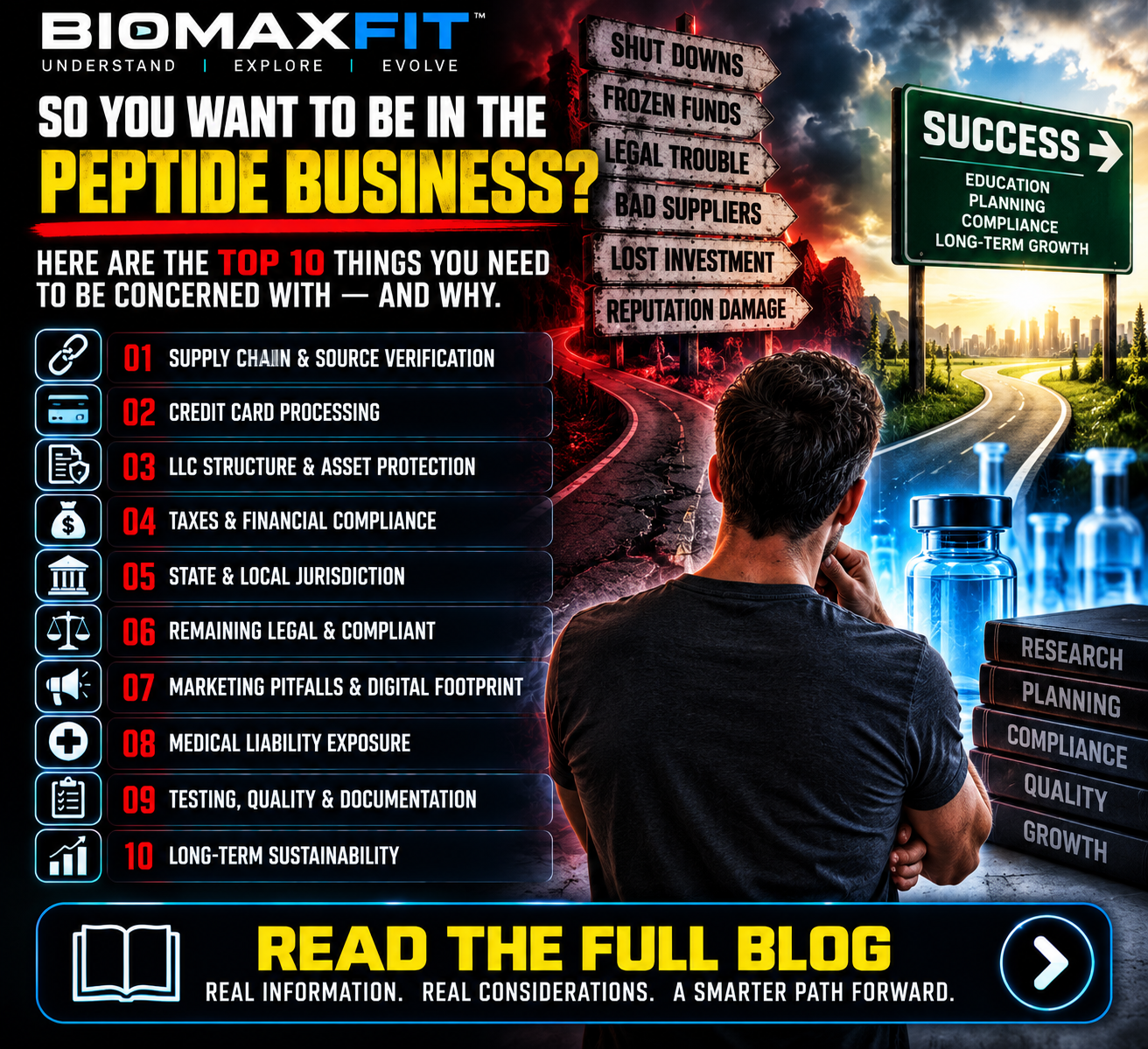
Entering the peptide business in 2026 without understanding the surrounding infrastructure can be a costly education. BioMaxFit examines ten business realities — from supply-chain verification and credit-card processing to marketing footprints and medical-liability lines — that anyone should understand before deciding whether this industry makes sense at all.
Educational & research use only. Not medical advice — we do not sell or promote any compounds. Read the full disclaimer.
A Deceptively Simple-Looking Industry
The peptide business can look deceptively simple from the outside.
Find a supplier. Build a website. Put up some products. Run social media. Accept credit cards. Ship orders.
Done, right?
Not even close.
In 2026, entering the peptide business without understanding the infrastructure surrounding it can be a very expensive education. Recent federal warning letters show regulators reviewing not only company websites, but also Facebook, Instagram, YouTube, product descriptions, educational material and other online content. They also repeatedly demonstrate that simply writing "Research Use Only" does not automatically override the rest of a company's conduct or messaging.
BioMaxFit doesn't sell peptides. Its role is education. So rather than telling anyone how to sell them, this article examines the business realities someone should understand before deciding whether this industry makes sense at all.
Here are ten of the biggest.
1. A Supply Chain Is the Foundation
A company can build the greatest website in the industry, but if it doesn't know what it's receiving, where it came from, how it was manufactured, how it was handled or whether the documentation can be trusted, everything else is secondary.
A supplier saying something is "99% pure" isn't the same thing as independently establishing what is actually in a batch.
The question reaches beyond price.
Who manufactured it? What documentation exists? Is there independent analytical testing? Can individual lots be traced? Are storage and transportation conditions appropriate? What happens when a test doesn't match the supplier's paperwork? What is the procedure for rejecting a questionable shipment?
And perhaps most importantly:
What happens when a supplier disappears tomorrow?
If an entire business depends upon one overseas contact, one payment channel or one source of inventory, that isn't much of a supply chain.
That is a dependency.
2. Credit-Card Processing Can Become a Business-Killer
This is one of the issues newcomers dramatically underestimate.
Opening a bank account and getting a merchant processor are not the same thing.
A processor may initially approve an account and later reconsider it based on the business model, products, chargebacks, underwriting information, website content or changes in risk tolerance.
And losing processing doesn't necessarily mean simply finding another company.
Imagine having inventory, payroll, advertising expenses and customers — and suddenly losing the primary method of accepting payments.
Then consider reserves, delayed settlements, chargebacks and frozen funds.
Before entering any higher-risk industry, it is essential to understand exactly how money gets in, through and back out of the business.
Revenue on a dashboard isn't the same thing as cash safely sitting in an operating account.
3. An LLC Isn't a Magic Force Field
"I'll just open an LLC."
That is the beginning of the conversation, not the end.
Where will the company actually operate?
Where is inventory stored?
Where are employees located?
Where are orders fulfilled?
Does operating from another state create registration, licensing, tax or reporting obligations?
What insurance does the business need?
How are personal and company assets separated?
The cheapest state to form an LLC isn't automatically the best place to operate one.
A beautiful corporate structure on paper means very little if the actual business operates completely differently.
It is worth spending money on qualified professional advice before building the structure — not after something goes wrong.
4. Taxes Get Complicated Fast
Online doesn't mean tax-free.
Selling across state lines can create tax and reporting questions that a local brick-and-mortar business may never encounter.
Then add inventory accounting, business expenses, payroll, contractor payments, state filings, federal filings, sales-tax obligations where applicable and potentially international supplier payments.
A shopping cart may run automatically.
Tax obligations don't.
A competent CPA who understands e-commerce and multi-state businesses can be far more valuable than another thousand dollars spent on advertising.
5. State and Local Governments Still Exist
One of the great misconceptions about internet businesses is:
"I'm online, so location doesn't really matter."
Physical operations still happen somewhere.
Inventory sits somewhere.
Packages leave somewhere.
Employees work somewhere.
Business records exist somewhere.
That can bring zoning, occupancy, business registration, taxation, employment, storage and other state or local requirements into the picture depending on what is actually being done.
Federal compliance isn't the entire compliance picture.
A ZIP code can matter just as much as a URL.
6. "Research Only" Doesn't Erase Everything Else
This deserves its own section because this issue is playing out in real time.
Some businesses appear to believe that putting:
FOR RESEARCH USE ONLY — NOT FOR HUMAN CONSUMPTION
at the bottom of a website solves the problem.
Recent federal warning letters demonstrate why that assumption is dangerous. Regulators have explicitly cited research-use disclaimers while concluding that other website content provided evidence pointing toward human use.
One particularly instructive 2026 letter discussed a company offering bacteriostatic water alongside a peptide guide and peptide calculator; another cited bacteriostatic water marketed as a means of reconstituting products.
The practical lesson is bigger than any particular phrase:
A disclaimer is part of a company's message. It isn't necessarily the whole message.
It is worth looking at the business as an outsider would.
Website. Products. Images. Articles. Videos. FAQs. Emails. Social media. Affiliates. Customer communications.
What does the entire picture communicate?
7. Marketing May Be the Biggest Digital Footprint
This may be the most underestimated issue on this entire list.
Everyone wants sales.
So businesses naturally start doing what normal e-commerce businesses do:
BOGO promotions.
Discount codes.
Influencers.
Affiliate programs.
Testimonials.
Transformation stories.
"How I use it" content.
Human dosing discussions.
Videos explaining expected effects.
Before-and-after imagery.
The problem is that this isn't necessarily an ordinary consumer-product category.
Recent enforcement letters specifically document reviews of companies' Facebook, Instagram and YouTube accounts in addition to their websites.
That should get every business owner's attention.
Marketing doesn't disappear into cyberspace.
It creates a record.
Posts can be screenshotted. Videos can be saved. Affiliate content can live outside a website. Old pages can remain discoverable long after a business has changed its strategy.
Before clicking POST, it is worth asking whether that same post would be comfortable to see displayed on a large screen in a conference room several years from now.
That is a pretty good filter.
8. Medical Liability Is a Line Not to Accidentally Cross
There is an enormous difference between discussing published scientific research and telling an individual what he or she should personally do.
That distinction matters.
Once a business starts answering questions about dosing, administration, reconstitution, expected effects, adverse reactions, interactions or whether someone should take something, it can create risks far beyond ordinary e-commerce.
And social media makes crossing that line incredibly easy.
Someone asks:
"How much should I take?"
An employee answers.
Someone asks:
"Can I use this with my medication?"
An affiliate replies.
Someone asks:
"Is this reaction normal?"
Customer service gives an opinion.
Those aren't ordinary shipping questions.
If a business model depends upon providing individualized human-use guidance, it needs qualified legal and healthcare professionals to determine whether it is operating within the appropriate professional and regulatory framework.
Medicine should not be improvised in a comments section.
9. Testing, Quality and Documentation Have to Be Real
A PDF labeled COA isn't quality control by itself.
Who performed the testing?
Was the laboratory independent?
Which analytical methods were used?
Does the report correspond to the actual batch being distributed?
Can the batch be traced from receipt through storage and distribution?
What happens if a later test contradicts the original result?
How are complaints documented?
How would potentially affected inventory be identified?
And could the company reconstruct what happened six months later?
Good documentation isn't glamorous.
Nobody posts a viral TikTok about inventory traceability.
But when something goes wrong, documentation can become one of the most important assets a company possesses.
If it matters, document it.
10. Build a Business That Can Survive Tomorrow
This may actually be number one.
A company shouldn't be built around what other businesses appear to be getting away with today.
It should be built around what can be responsibly defended tomorrow.
Regulations change.
Payment processors change.
Suppliers disappear.
Social-media platforms change their policies.
Advertising accounts get restricted.
Banks change their risk tolerance.
Products become controversial.
Enforcement priorities evolve.
Competition pushes margins down.
A business built entirely around one supplier, one processor, one social platform, one product category or one interpretation of the rules is fragile.
The question isn't simply:
"Can money be made doing this?"
The better question is:
"Can something legitimate, documented and sustainable enough be built that it is still worth owning five years from now?"
The Bonus Item: Know When to Pay Professionals
Entrepreneurs naturally want to save money.
There are plenty of places to do it.
A corporate attorney probably shouldn't be one of them.
Neither should an accountant, insurance professional, laboratory-testing strategy or compliance review.
A few thousand dollars spent identifying problems before launch can look remarkably inexpensive compared with discovering those same problems after inventory, customers, employees and liabilities have accumulated.
And relying on Facebook groups for legal advice simply because someone has been selling peptides for three years without experiencing a problem is not sound practice.
"Nothing has happened to me yet" isn't a compliance strategy.
The Bottom Line
There may be real business opportunities surrounding scientific research.
But there is an enormous difference between recognizing an opportunity and being prepared to operate responsibly within it.
If someone is seriously considering entering the peptide business, the starting point shouldn't be:
What should I sell?
It should be:
What is actually being built?
Who are the legitimate customers?
Where will the materials come from?
How will quality be independently verified?
How will money move?
Where will the company legally operate?
What insurance and professional guidance is needed?
What will the marketing communicate?
Where are the lines that absolutely will not be crossed?
And what happens when something goes wrong?
If those questions can't be confidently answered, there is probably no readiness to worry about logos, labels and launch dates.
The peptide itself may be the smallest part of building a peptide business.
BioMaxFit is an educational research platform. It sells nothing. This article is general educational and industry information and is not legal, tax, medical, regulatory or financial advice. Businesses should obtain advice appropriate to their products, activities and jurisdiction.