Responsible Sourcing
The Hidden Risk Behind Grey-Market Bacteriostatic Water
Why supply-chain integrity matters more than price — and what every buyer should know about unverifiable sources.
Educational & research use only. Not medical advice — we do not sell or promote any compounds. Read the full disclaimer.

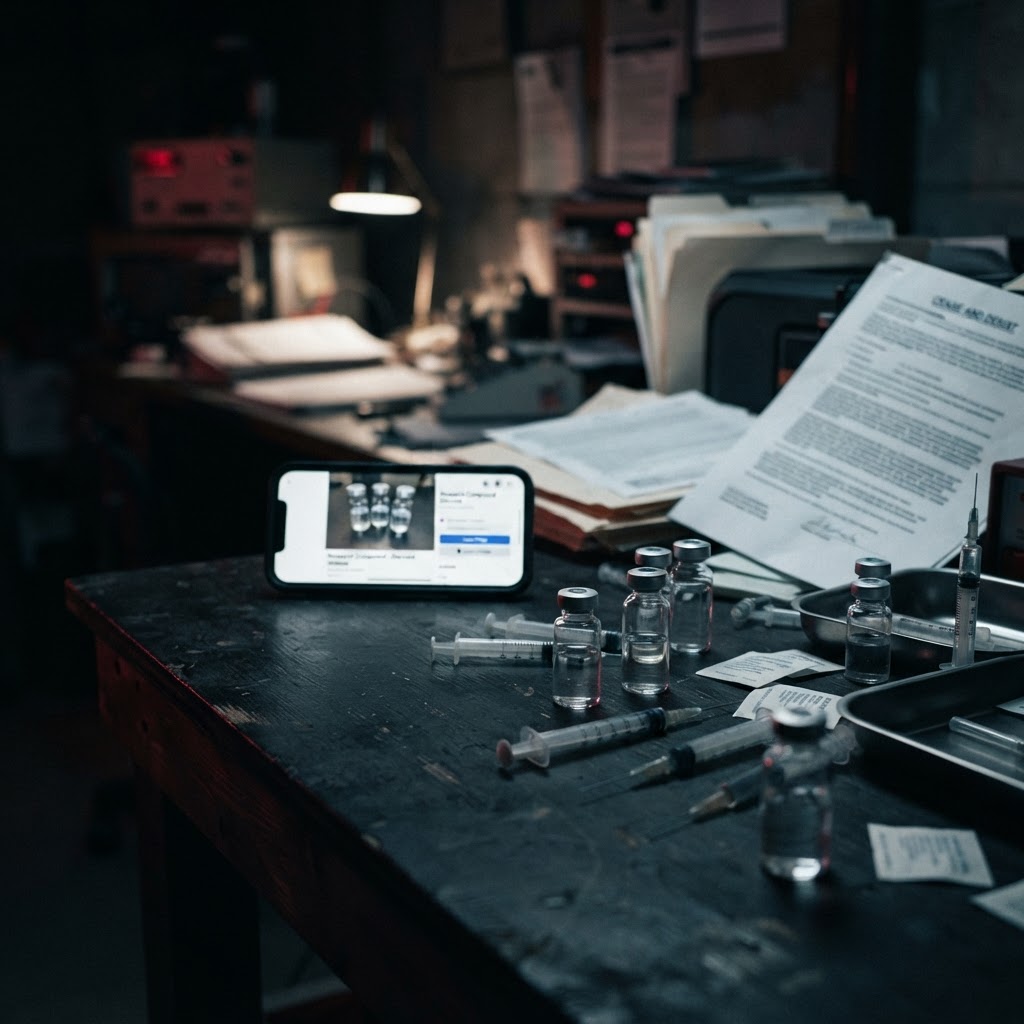
Growing demand for research and laboratory products has attracted an unregulated secondary market. Bacteriostatic water is one product increasingly offered through online marketplaces, social-media sellers, and overseas intermediaries whose actual manufacturing source can be difficult—or impossible—to independently verify.
The low price can be attractive. The uncertainty behind that price should not be.
More Than "Water in a Vial"
Legitimate bacteriostatic water is a carefully manufactured preparation. When a product is intended for applications requiring sterility, seemingly small deviations in manufacturing, filling, packaging, or storage can create significant consequences.
This isn't theoretical. FDA has previously reported a nationwide recall of Bacteriostatic Water because sterility assurance could not be confirmed, warning that use of potentially nonsterile product could create risks including serious bacterial infection. That incident involved a regulated manufacturer inside a formal pharmaceutical system.
If sterility requires this level of attention inside a regulated supply chain, what assurance does a buyer have from an unverifiable source?
The Grey-Market Problem
A grey-market transaction can involve many layers—manufacturers, trading companies, brokers, relabelers, resellers—before reaching the final purchaser. With each layer, traceability becomes harder.
A buyer may receive a professional-looking vial, label, lot number, or certificate without independent confirmation of who manufactured it, where, under what controls, whether the formulation is accurate, or whether documentation corresponds to the actual material.
Country of origin alone doesn't determine quality. The relevant question isn't "Where was this made?" but "Can the entire supply chain—and the quality system behind this specific product—be independently verified?"
A Certificate Is Not a Supply Chain
Grey-market sellers understand that buyers want reassurance, so products may arrive with certificates, lab reports, photographs, or batch numbers. Documentation can be valuable—but it should be verifiable.
Does the laboratory exist? Can the report be authenticated? Does the lot number match the product? Were the appropriate tests actually performed? Can the manufacturer be identified and qualified?
The objective isn't to collect paperwork. It's traceability.
Price Should Never Replace Due Diligence
Global sourcing is fundamental to modern commerce. Excellent manufacturers exist throughout Asia, Europe, and North America. The issue is not geography—it's accountability.
When quality, purity, formulation, or sterility matter, procurement should prioritize supplier qualification, manufacturing transparency, documentation integrity, and independent verification. Saving a few dollars per unit is meaningless if you cannot confidently determine what is inside the container.
Know Your Source
International e-commerce has made global sourcing easier than ever. It has also made it easier for an unknown intermediary thousands of miles away to appear as an established manufacturer.
For BioMaxFit, responsible sourcing begins with a simple principle:
Know the source. Verify the supply chain. Demand accountability.
Because when quality matters, the cheapest supplier can ultimately become the most expensive decision you make.
BioMaxFit — Informed choices. Better outcomes.
This article is provided for general informational and awareness purposes only. BioMaxFit does not sell, promote, or recommend any peptide, compound, or company. It is not medical advice and should not be interpreted as instructions for the preparation, compounding, administration, or use of any pharmaceutical or medical product.